
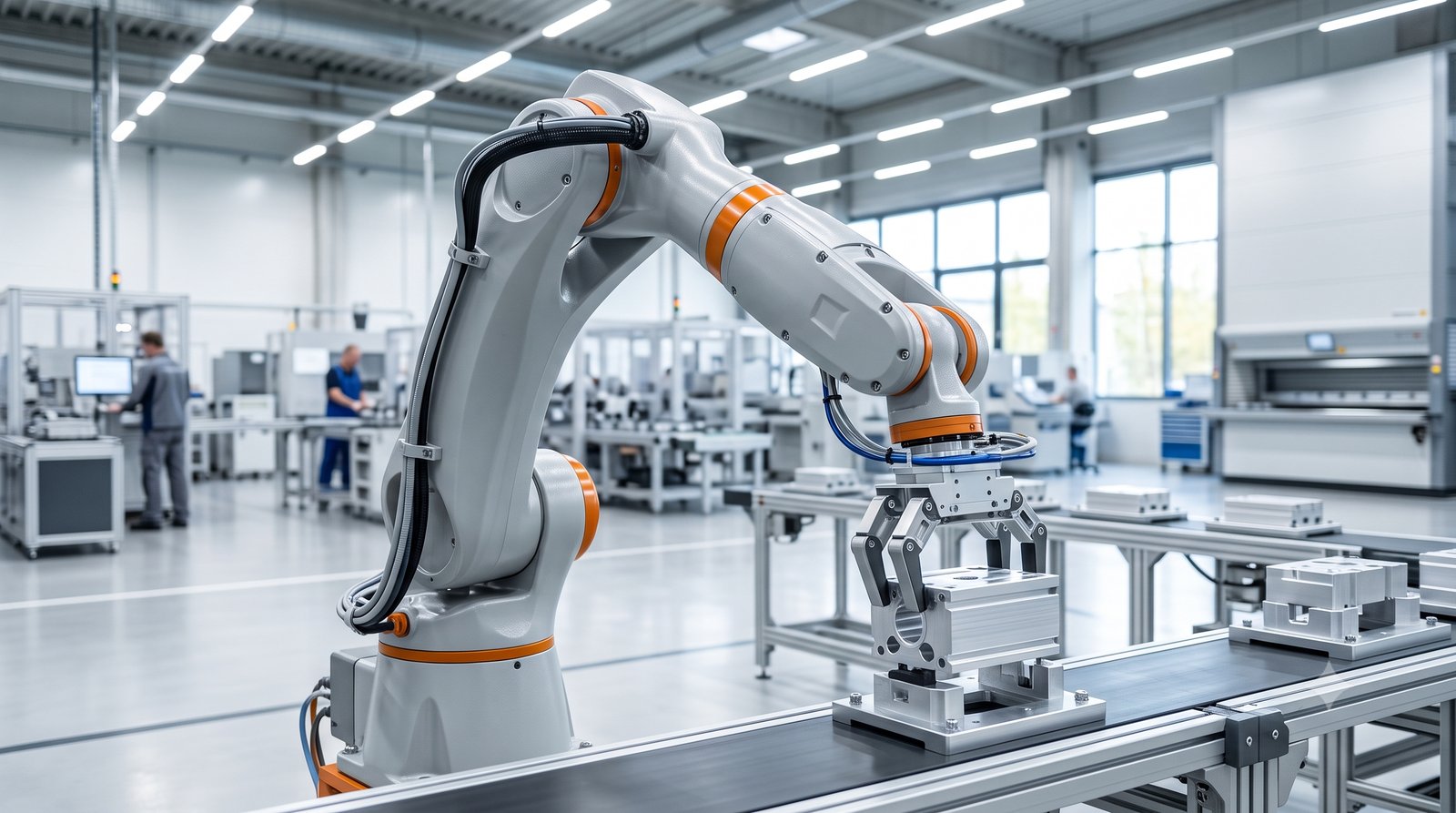
Every factory has a bottleneck, and it nearly always goes by the name of a repetitive task: the part someone picks up and positions thousands of times a day, the pallet someone stacks, the weld someone repeats. That is where production jams and where the labour is missing. The one who sees the opportunity is not the person who wants a robot, but the factory owner who found out that the arm which solves that bottleneck has left multinational pricing behind and become an investment with a calculable return.
What an industrial robotic arm is
The robotic arm is an articulated robot that carries out a repetitive production task: picking and placing parts (pick-and-place), palletising, welding, painting, assembling or packing. It does not tire, it does not miss a shift and it keeps the same precision all day long. There are two main types, and the difference decides where it fits into your factory:
The traditional industrial arm works in a fenced-off area, chosen for speed and strength. The cobot, or collaborative robot, works alongside the operator without a cage, with sensors that stop it on contact, and it was the cobot that opened up automation to the smaller company. China manufactures both at scale, at a price far below the traditional brands.
Models and variations
"Robotic arm" is not a single product. In the aisles of the Chinese robotics fair it is a whole family, and each type solves a different bottleneck:
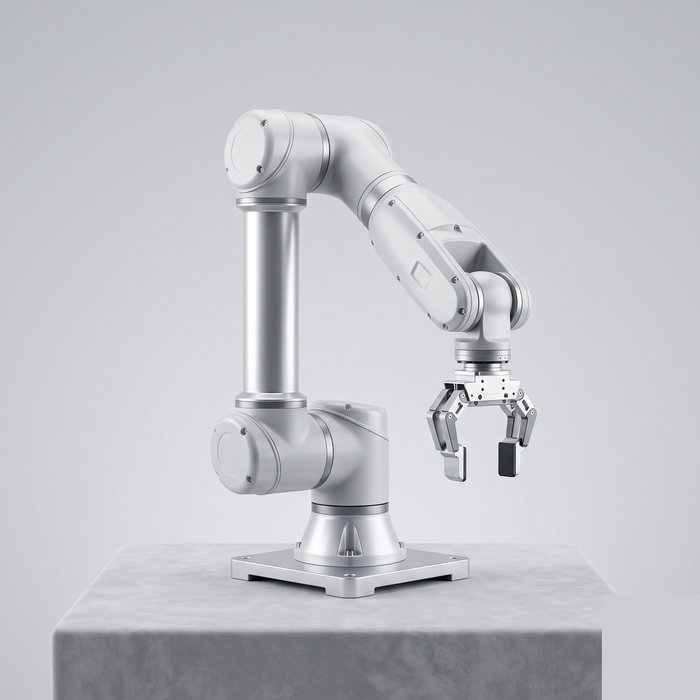
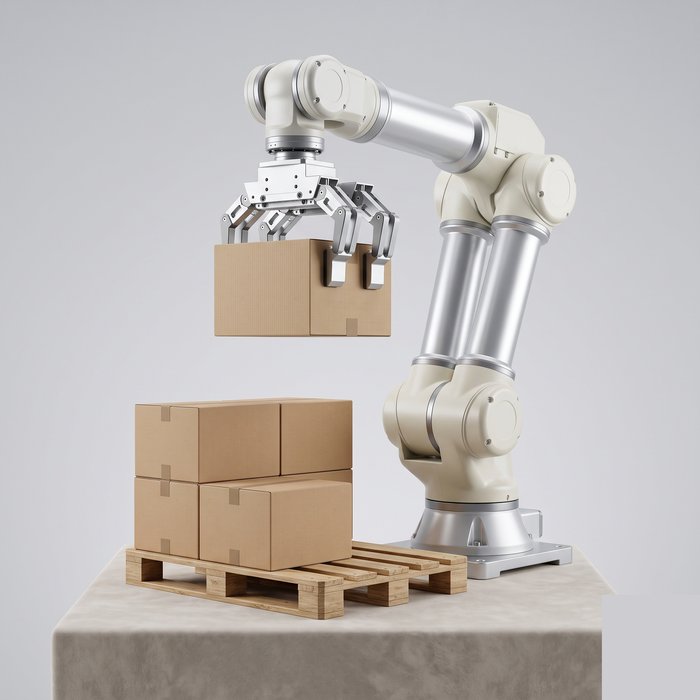
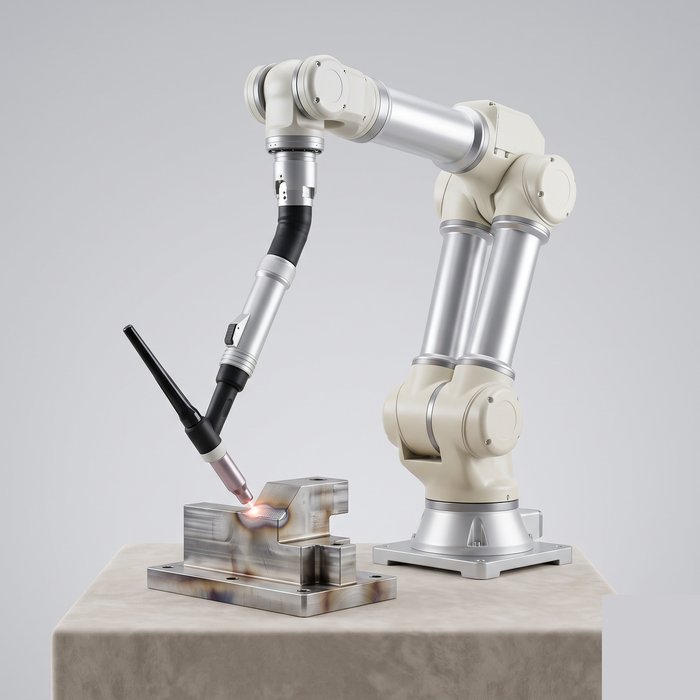
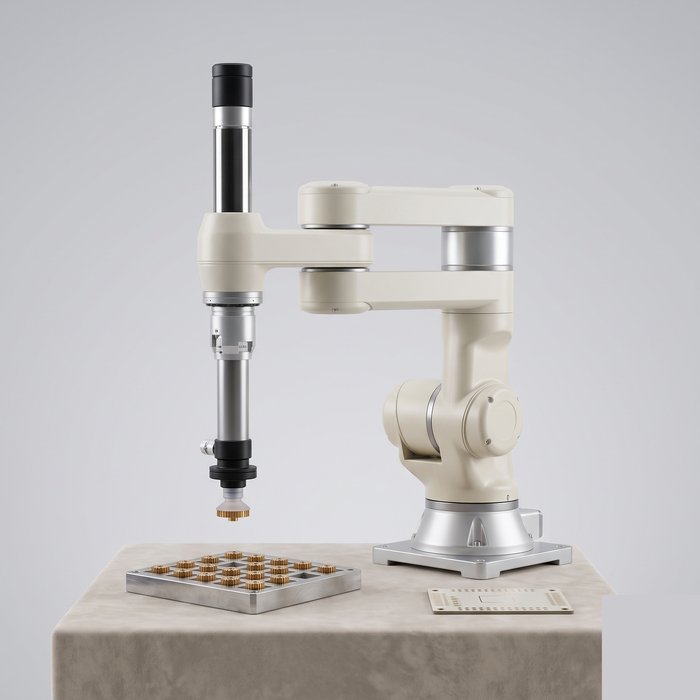
It is this variety that makes the trip worthwhile. The cobot solves the assembly line without any building work; the palletiser takes the weight off the worker's back at the end of the line; the SCARA speeds up the assembly of small parts. Seeing all four running side by side is what shows which one solves your bottleneck.
Why this is an opportunity for Brazil
Brazilian industry needs to automate in order to compete, but it has always come up against the price. The Chinese robot changes those sums, and it arrives at a moment when labour for repetitive tasks is ever harder and more expensive to hire and to keep.
- A return you can calculate: this is not an impulse product. The buyer knows how many shifts and how many months the robot takes to pay for the cost it replaces. It is the most rational purchase there is, decided with numbers.
- Automation within reach: the Chinese price makes it viable to automate the small and medium-sized factory, not just the large one, which opens up a whole market in Brazil.
- Two buyers: it serves the manufacturer automating their own line and the integrator or distributor who wants to represent the brand in Brazil, with recurring sales of service, integration and parts.
- Timing: the typical lead time is 60 to 120 days, plus the integration time. Whoever closes at the October fair has the cell running at the start of the following year.
Before importing: a robot is work equipment and falls under NR-12, the machine safety standard, which requires guards, an emergency stop, a demarcated area around the robot and a manual in Portuguese. Confirm the voltage (220V or 380V three-phase), the INMETRO certification of the electrical side and, above all, the integration, the programming and the training: a robot without integration does not produce. This is a case where inspecting before shipment confirms that the cycle works. See also how to import industrial equipment from China.
Customise the specification (OEM)
Importing automation from China is not a matter of picking the robot from the catalogue and plugging it in. The project has to be specified, and that is where the investment pays off or is lost:
- Reach and load: the working radius and the payload define what the robot can do. Sizing it wrong means buying too little or paying for capacity you do not use.
- The end-of-arm tool: the gripper, the welding torch or the vacuum cup the robot uses changes according to your part, and it is part of the project, not an accessory.
- Integration and software: the programming for your task, the interface in Portuguese and the training of the team, which is what actually makes the robot produce.
- Support and parts: a commitment to technical support and a continued supply of parts, which keep the operation going in the second year.
That calls for direct negotiation with the factory and a project validated before the batch. BCVN finds the right manufacturer, sizes the cell, secures the NR-12 side and the integration, and validates the support.
Where to buy robotic arms in China
Chinese robotics is concentrated in the dedicated industrial fair and in the machinery aisle of the universal fair:
- CIIF (automation and robotics, Shanghai): from 12 to 16 October, it includes the robotics show (RS) and the automation show (IAS), the largest concentration of manufacturers in the sector. It is the ideal fair for whoever is going to automate.
- Canton Fair, Phase 1 (machinery): from 15 to 19 October, with automation manufacturers among the wider industrial offering. Good for anyone combining the robot with other purchases.
- Industrial equipment guide: the step by step of how to import heavy machinery from China, from the project to customs clearance.
The itinerary the dates draw for you: CIIF (12 to 16 October, Shanghai) and Canton Phase 1 (15 to 19, Guangzhou) overlap by a few days, a short flight from one another. You can see the depth of robotics in Shanghai and the general variety in Guangzhou on the same trip. See the full 2026 trade fair calendar.
It is also worth looking at the welding machine and power tools and the benchtop CNC laser machine, which round off the modernisation of production.
The robotic arm is not the distant future of Brazilian industry, it is a decision that already fits the present for many factories, now that the price has stopped being prohibitive. It does not sell on impulse, it sells on arithmetic, and that is why it is the kind of import that most rewards whoever goes to the source: here you do not buy a machine, you buy a project that needs the right cell, the right standard and a manufacturer who will still support you next year. For whoever produces in Brazil, it is the employee who never misses a shift.
Frequently asked questions about importing industrial robotic arms
What is an industrial robotic arm and a cobot?
It is an articulated robot that carries out a repetitive task in production: picking and placing parts, palletising, welding, painting, assembling or packing. The traditional industrial arm works in a fenced-off area, chosen for speed and strength; the cobot, or collaborative robot, works alongside the operator without a cage, with sensors that stop it on contact. China has become one of the largest manufacturers of both, at a price far below the traditional brands.
Does a robotic arm imported from China need certification?
Yes, and this is the most important point. A robot is work equipment and falls under NR-12, the machine safety standard, which requires guards, an emergency stop, a demarcated area and a manual in Portuguese. Also confirm the voltage (220V or 380V three-phase), the INMETRO certification of the electrical side and, above all, the integration, the programming and the training, without which the robot does not produce. Automation outside the standard creates labour liabilities and a risk of accidents.
Can I import a single robot just to test it?
A robot is a project purchase, not a stand-alone trial. BCVN is an import consultancy for companies and integrators, and the decision is taken on return on investment, with the sizing, the integration and the support defined beforehand. It makes sense for whoever is going to automate a line, for the integrator and for the distributor who wants to represent the brand in Brazil, with service and parts behind it. It is not a product to buy as a single unit without a project.
Where can I buy robotic arms in China?
At CIIF, in Shanghai, from 12 to 16 October 2026, which includes the robotics show (RS) and is the largest concentration of automation manufacturers in the country, and at the Canton Fair, Phase 1, from 15 to 19 October, in the machinery aisle. CIIF gives you depth in automation; the Canton Fair gives you the robot among other categories. BCVN validates the manufacturer, the NR-12 side, the integration and the support.