
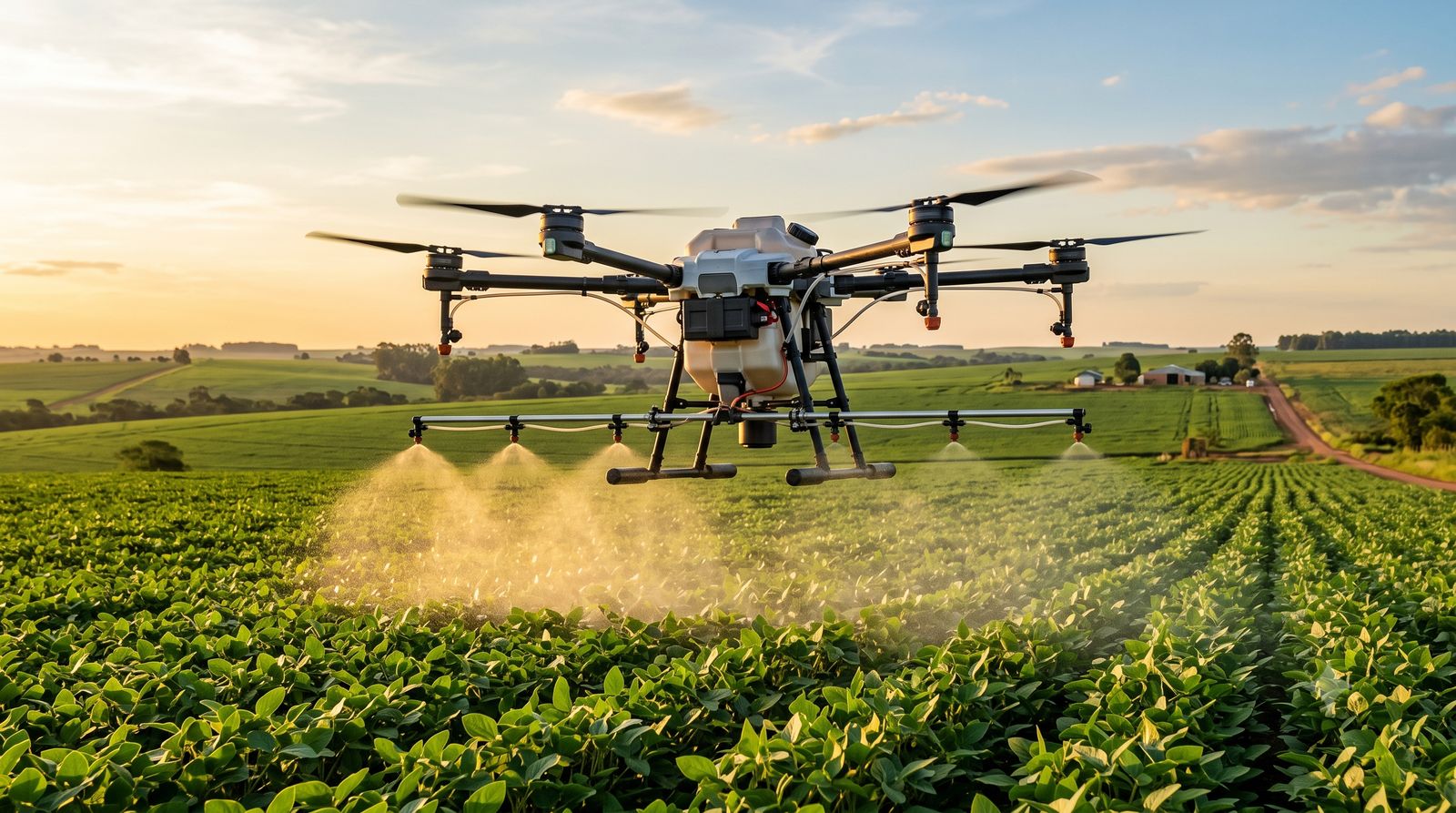
The scene is already common in the countryside. The farmer opens an app on the tablet, marks the boundaries of the plot and watches the drone lift off, go and come back on its own, applying crop protection products in exact strips while he follows from the side of the road. Only the person who really profits from that scene is not just the owner of the land: it is the farmer who started offering spraying as a service to the neighbours, and the importer who realised that Brazil is the perfect field for a machine China builds better and cheaper than anyone.
What the agricultural spraying drone is
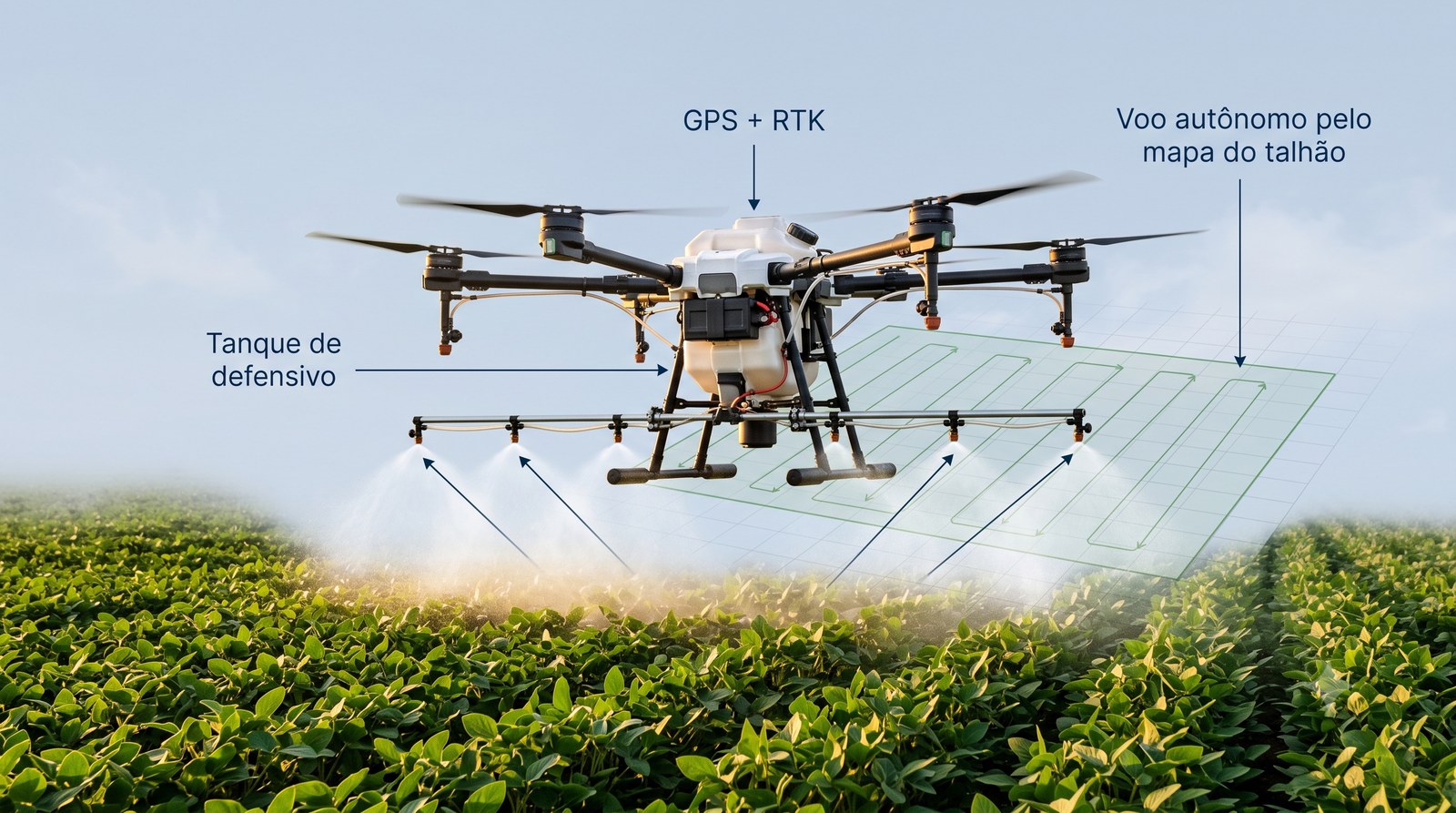
The agricultural drone is an unmanned aircraft with a tank for crop protection products or fertiliser and a nozzle system that applies the product in low flight, following a map of the plot. It uses GPS and, in the better models, RTK correction, which gives centimetre precision, plus radar to follow the terrain and avoid obstacles. Tanks range from around 10 litres in entry models to 50 litres or more in production ones.
It does not replace the crop-duster aircraft on large expanses, but it solves what neither the aircraft nor the tractor handles well: the small and medium plot, uneven terrain, the waterlogged field where a tyre cannot go and the localised application that saves inputs.
Why this is an opportunity for Brazil
Brazil is one of the world's great agricultural powers, with an enormous base of small and medium properties still without access to precision spraying. That is exactly the gap the agricultural drone fills, and the opportunity serves two importer profiles at once: whoever buys for their own land and whoever buys to provide a service or to resell.
- Equipment that becomes a business: many farmers do not buy the drone only for themselves, but to charge for the application on neighbouring farms. It is one of the rare pieces of farm equipment where the service work pays for the machine in a few harvests.
- Cheap at source, high value in the field: China concentrates the world's leading manufacturers, and the cost at source is far lower than that of an equivalent already nationalised. That opens up margin both for own use and for resale, with continuous repeat purchases of batteries and parts.
- Harvest timing and lead time: machinery is not an impulse buy. Between manufacturing, sea freight and clearance, counting on 60 to 120 days means placing the order well before the application window of the season.
- A concrete gain: less water and less product per hectare, application on terrain machinery cannot reach and nobody directly exposed to the product on the ground.
Compliance: the point that separates the serious importer from the amateur
Here it is worth being direct, because this is the most heavily regulated product in the whole Showcase, and pretending otherwise would be a disservice. The agricultural drone is not a toy you switch on and fly: in Brazil it is an aircraft that applies agrochemicals, and it answers to four sets of rules at the same time. Understanding that before importing is what separates whoever builds a lawful operation from whoever buys an expensive headache.
ANAC (aircraft registration): every drone above the weight limit needs to be registered on SISANT, ANAC's system for unmanned aircraft. Agricultural models, with a full tank, fall into the categories that require registration and, very often, an identified pilot.
DECEA (airspace): each operation needs authorisation to use the airspace, requested through the SARPAS system. It is not a free flight; it is an air operation that follows rules on height, area and time of day.
ANATEL (radio homologation): the control link, the telemetry and the RTK use radio frequency, and the equipment needs ANATEL homologation to operate lawfully in the country.
MAPA and agrochemicals: in order to apply crop protection products, the drone must be registered as an agricultural aircraft and the operation follows MAPA's agricultural aviation rules, with an agronomic prescription, authorised products, a trained operator and the environmental and state rules that apply to spraying.
The rules of the four bodies change frequently, and there are details that vary by state and by size of equipment. That is why the golden rule is to confirm the current requirement before placing the order, and not after the machine is already at the port. This barrier frightens the amateur, but for whoever has a partner it is precisely where the value sits: importing the right model, with the documentation and the homologation already under way, is what turns imported equipment into an operation that runs without surprises.
It is also why this is the find that most calls for support. BCVN is neither a customs broker nor a regulatory consultancy, but it knows the path, validates the manufacturer that supplies the necessary technical documentation and connects the importer to the right support so nothing stalls at the moment of operating.
Customise the specification (OEM)
Importing an agricultural drone from China is not a matter of taking the catalogue model and hoping for the best. The manufacturer adjusts the equipment to your use, and that is where having a partner at source separates whoever resells a commodity from whoever builds a serious operation.
- The right capacity and configuration: a tank of 10 to 50 litres, the number of nozzles, RTK precision and spare batteries so nothing stops in the middle of the season.
- Your brand on the equipment (private label / OEM) and a manual in Portuguese, for whoever will resell it as their own line.
- After-sales and parts agreed at the time of purchase: batteries, pumps, propellers and the technical support, which on flying equipment is not a detail, it is what keeps the operation alive.
That calls for negotiating directly with the factory and validating a sample before the batch. BCVN finds the right manufacturer, closes the specification, tests the equipment and makes sure the after-sales really exists, and not only in the proposal.
Where to buy agricultural drones in China
China is the world's birthplace of the agricultural drone, and the equipment appears both at the big general fairs and at the dedicated agricultural ones:
- Canton Fair, Phase 1 (Machinery and Equipment): the biggest starting point, with farm machinery and drone manufacturers side by side.
- Hong Kong Electronics Fair: strong on the electronics and navigation side of drones, it takes place days before the Canton Fair.
- CIAME (farm machinery fair): the sector fair dedicated to agriculture in China, where the spraying drone manufacturers show their full ranges. It is where you go deeper into what the Canton Fair presents.
Next edition, Canton Fair 2026 (140th): Phase 1, with machinery and equipment, runs from 15 to 19 October 2026, at the Pazhou Complex in Guangzhou. The Hong Kong Electronics Fair (13 to 16 October) comes just before it, which makes it possible to combine the two in a single trip and see the equipment up close before deciding.
Read the complete guide to the Canton Fair 2026
The agricultural drone is not the easiest bet in the Showcase, and that is precisely why it is the most valuable. The regulatory barrier that scares off the unprepared buyer is the same one that protects the margin of whoever does it properly. For the Brazilian importer, the question is not whether the countryside wants the product, but how to buy the right model, from the manufacturer that supplies the documentation, with the after-sales service that sustains every season. It is a decision for whoever treats importing as a business, not as an adventure.
Frequently asked questions about importing agricultural drones
Do I need registration or certification to operate an agricultural drone in Brazil?
Yes, and it is the most heavily regulated product in this sector. Broadly speaking, the drone needs to be registered with ANAC (SISANT), the operation requires airspace authorisation from DECEA (SARPAS), the radio equipment needs ANATEL homologation and, in order to apply crop protection products, it must be registered as an agricultural aircraft and follow MAPA's rules, with an agronomic prescription and a trained operator. The rules change, so always confirm the current requirement before importing and operating.
Is it allowed to spray pesticides with a drone in Brazil?
Yes. Agricultural application by drone (RPA) is regulated in Brazil and has been expanding, but it is subject to registration of the equipment and of the operator with MAPA as agricultural aviation, to the agronomic prescription and to environmental rules. It is not a free flight: it is a regulated operation. BCVN guides the path and connects the importer to the right technical support.
How much does it cost to import an agricultural spraying drone from China?
China dominates manufacturing and the cost at source is far lower than that of equivalent equipment already nationalised, which opens up margin for anyone who will use it on their own land or provide a spraying service. The price varies with tank capacity (from 10 to 50 litres or more), the RTK precision system and the after-sales package. BCVN quotes the right model and the parts support.
Where can I find agricultural drone suppliers in China?
At the Canton Fair (Phase 1, machinery and equipment), at the Hong Kong Electronics Fair and, above all, at dedicated agricultural fairs such as CIAME. China concentrates the world's leading agricultural drone manufacturers. BCVN validates the manufacturer, the after-sales service and the supply of parts and batteries.