
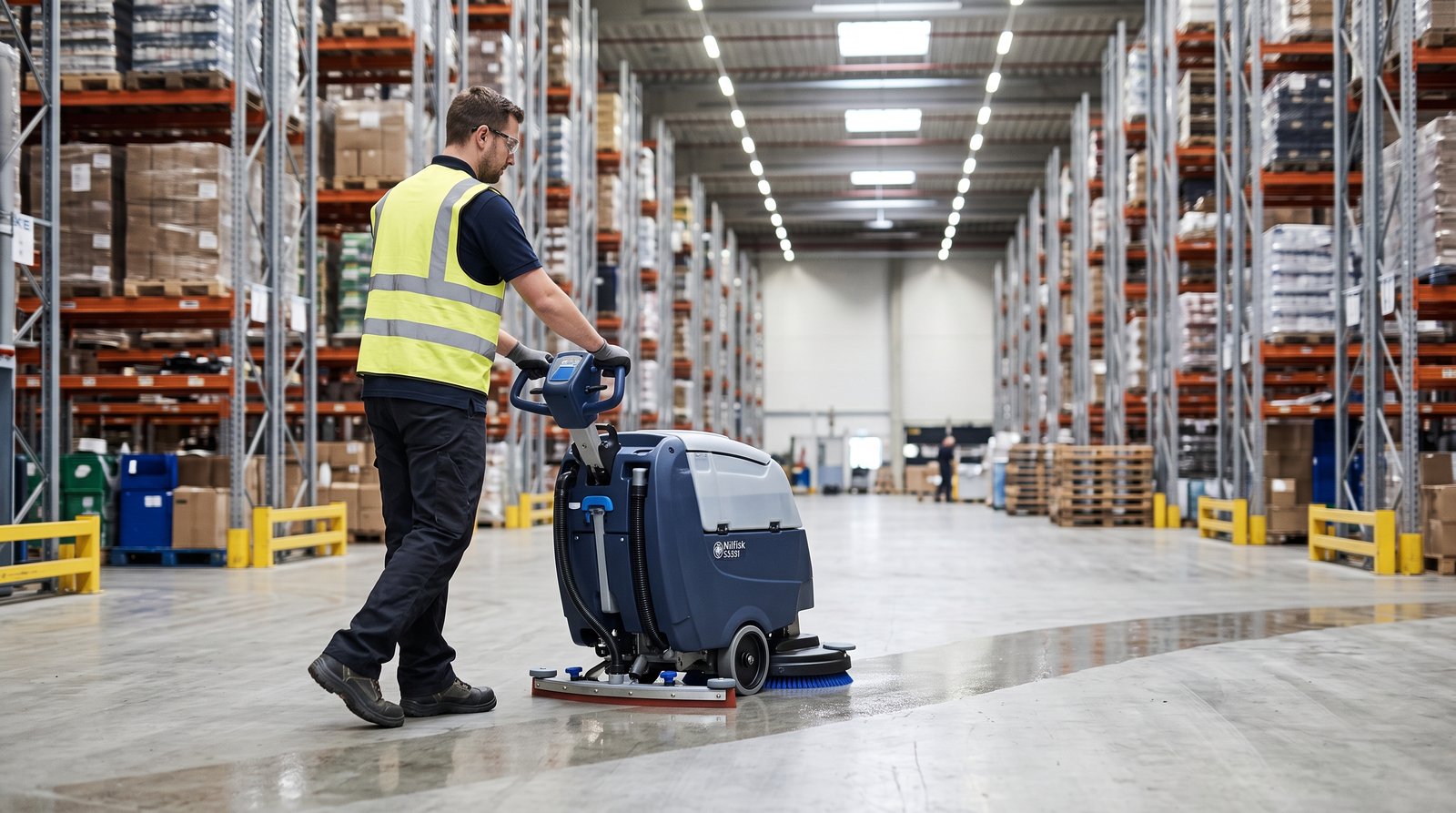
The two-wheeled bucket crosses the supermarket aisle at five in the morning. Behind it it leaves a wet strip, a yellow cone and a stretch of shop floor nobody may tread on for twenty minutes. That is how it went for decades, and the problem was never the dirt. It was the clock. Whoever sells a cleaning service is paid by the square metre delivered, and every minute of closed-off floor is a square metre that earns nothing. That detail, and not the machine, is what moves this market.
What a professional floor scrubber is
It is the machine that does three things in a single pass: it wets the floor with a mix of water and detergent, scrubs with a rotating cylindrical brush or disc, and recovers the dirty water through a squeegee at the rear. The result is a floor already dry right behind the machine. Inside there are two separate tanks, one for clean solution and one for recovery, which means the dirt leaves the ground and goes into a tank instead of being spread from a bucket that grows darker with every dip of the mop.
The difference becomes obvious when you look at what each method leaves behind. The damp cloth dilutes the dirt and redistributes it; the scrubber removes it and takes it away. And the dry floor changes the whole operation: with no wet strip there is no cone, no closed-off aisle and no slip risk, which allows cleaning with the shop open, with the warehouse moving and with the shift running. For the reseller, that is the argument that closes the sale, because it does not talk about cleaning, it talks about how much of the area stays available.
Models and variations
It is not a single product. At the fair it is a whole family, split by the size of the area and by the type of debris, and each band comes from a different chain of factories.
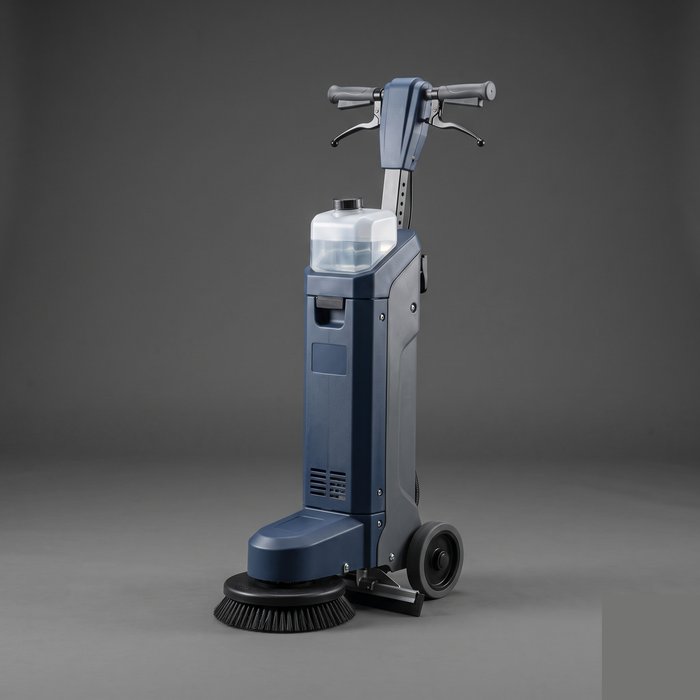
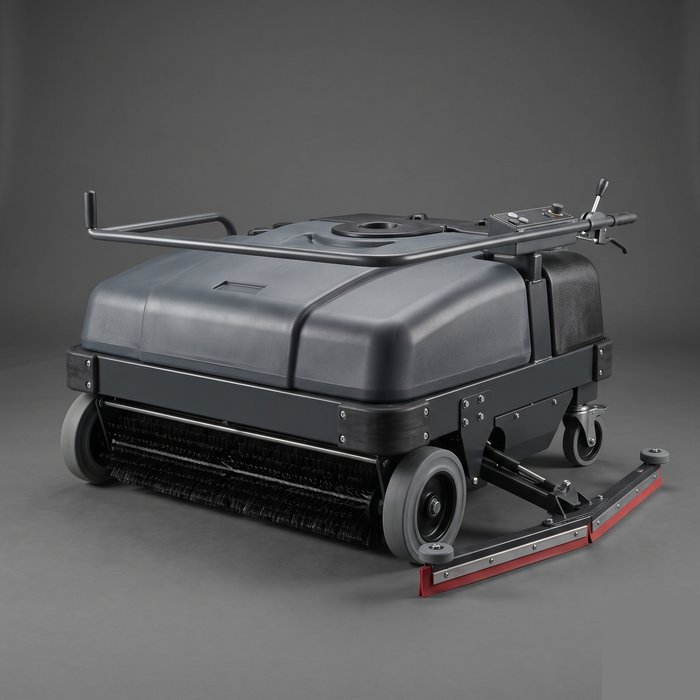
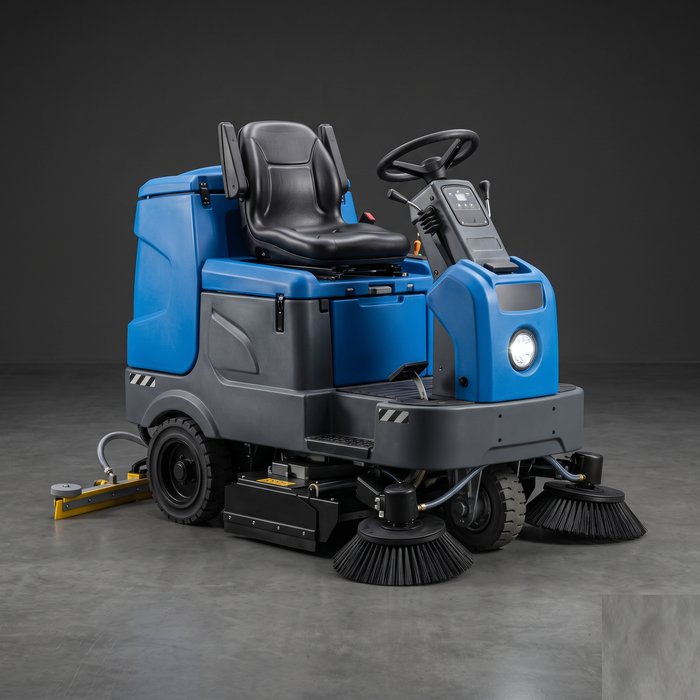
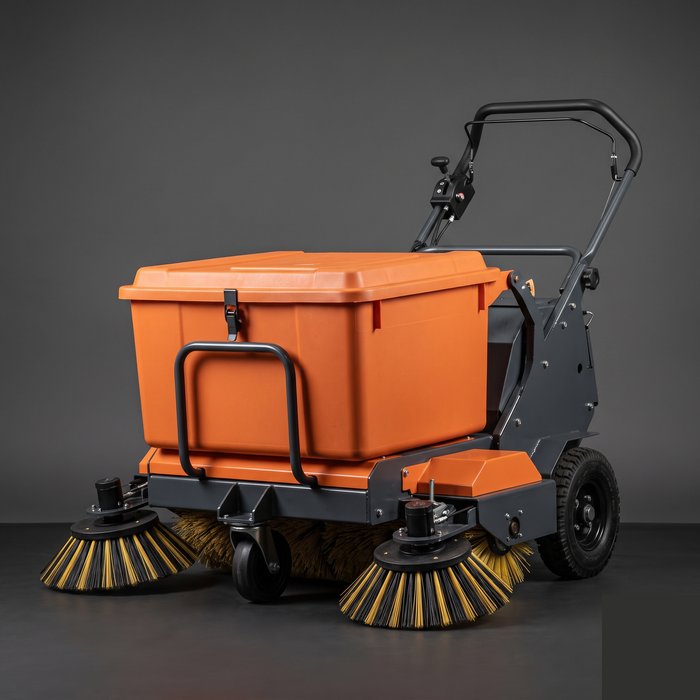
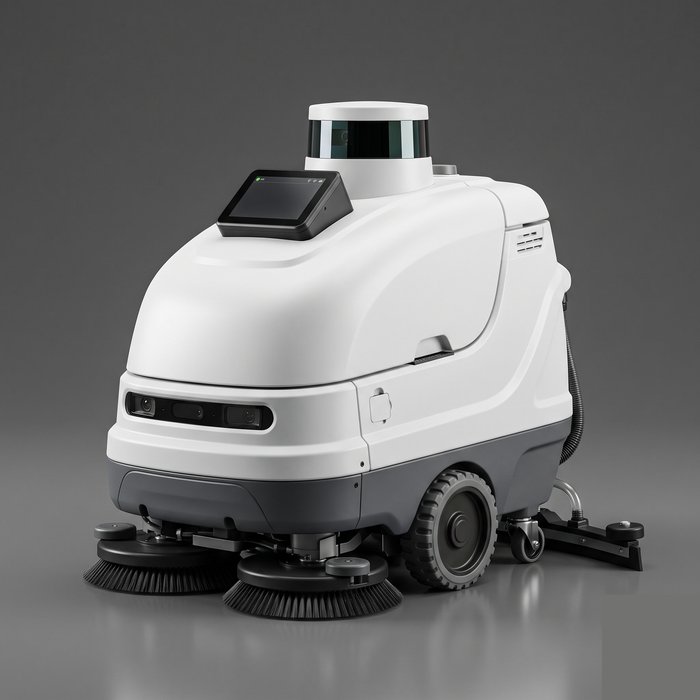
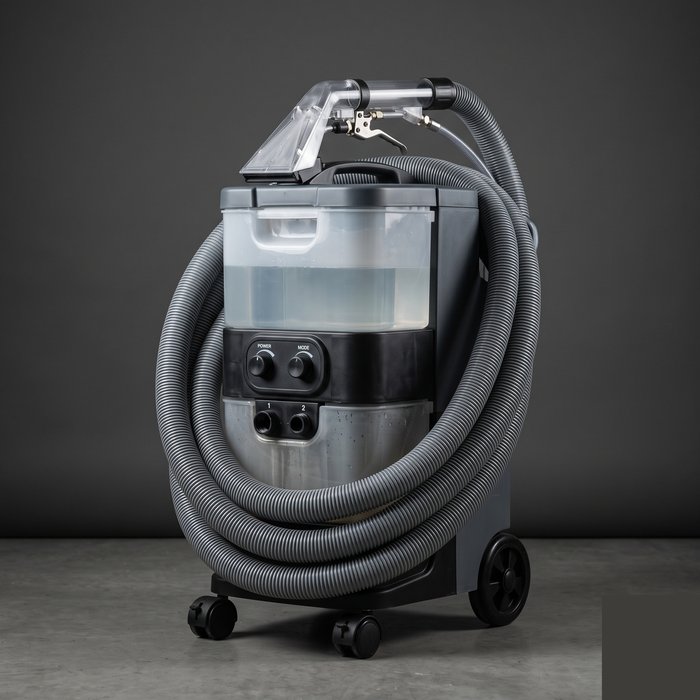
Choosing which of those bands to enter, and finding the factory that keeps the whole batch identical to the approved sample, is where BCVN comes in.
The sum the buyer makes before asking the price
Every commercial cleaning proposal has one invisible line: square metres per hour. It is the figure that decides how many people the contract needs, and the only one the buyer really compares. The mop and bucket manage something in the region of two to three hundred square metres an hour, with the floor closed off while it dries. A walk-behind with a narrow brush, in the half-metre band, has a catalogue output of between one thousand five hundred and two thousand square metres an hour. A ride-on with a wide brush goes past four thousand.
Except that the catalogue figure is the theoretical one, measured in a straight line and with a full tank. Practice knocks thirty to forty per cent off it, with manoeuvring around gondolas, islands and stacks of pallets, and with the time spent filling the solution tank, emptying the recovery tank and recharging the battery. Whoever sells knowing this builds the proposal on the real figure and is not contradicted in the first month of the contract, which is exactly when the competitor who promised the catalogue figure loses the account.
There is a second line in the same sum, and it usually settles the tie. The bucket uses water and product with no control, because the operator changes it whenever it looks dirty. The scrubber doses the solution by the metre travelled and returns the dirty water to a closed tank, which cuts chemical consumption and settles disposal in one place. In an industrial kitchen, in a food plant and in a hospital that stops being a saving and becomes an audit requirement, because a record of how the area was cleaned now exists.
NR-12, INMETRO and the battery: what decides the order
This is the point at which a lot of machine imports go wrong, and not for want of warning. NR-12 does not speak only about whoever uses the equipment: the text reaches the manufacture, the import, the sale, the display and the loan of machines and equipment. In other words, whoever brings the scrubber in from abroad answers for it as if they had built it. That is not an obstacle, it is the purchase specification, and it fits into five items that the Chinese factory meets without any fuss when they are asked for in writing.
- An instruction manual in Portuguese, covering the operating, maintenance and safety procedures. It is the first item an inspector asks for and the cheapest one to settle at source.
- An emergency stop the operator can reach from the normal working position, with manual reset, and not a simple off switch on the panel.
- Guarding on the moving parts, chiefly on the brush assembly and the drive belt, fixed in a way that requires a tool to open.
- A control that requires the operator's presence, the dead man's lever that cuts the drive the moment the hand leaves the handlebar.
- A seat sensor on the ride-on models, which interrupts the drive when the operator stands up. On machines with the operator aboard, it is the item most often missing from the standard export configuration.
On the electrical side, the care changes with the model. Corded machines need a voltage that matches the client's socket, and Brazil lives with 127 and 220 volts in the same city, which makes a dual-voltage motor or a per-batch voltage decision a matter for the order and not for the stockroom. The battery charger is the component that comes closest to the scope of compulsory certification, and the practical rule is to check where each item falls by its tax code before closing, and not after the cargo is already on its way.
The battery is the third decision, and it moves the freight. The sealed lead-acid one, of the AGM type, is cheaper and heavier, takes fewer cycles and needs a recharge gap between shifts; being non-spillable, it usually ships without dangerous-goods treatment. The lithium one weighs far less, accepts a partial top-up over the break and carries two shifts, but it ships as class 9 dangerous goods, with a UN 38.3 test report, a safety data sheet and its own packaging, and there are carriers that refuse it or charge more. One small detail is also worth noting, the one an experienced buyer raises in the first meeting: the squeegee rubber has to suit the client's floor, because the polyurethane one stands up to epoxy floors and to oil, and the natural rubber one does not.
Why this is an opportunity for Brazil
On the demand side, the country has outsourced its cleaning and now buys it by contract, with tight competition and a margin set inside the headcount calculation. On the supply side, whoever serves that buyer is nearly always the agent of an imported brand, with high spare prices and delivery measured in weeks, or a distributor who brought in one container of a single model. The gap between the two is exactly where an importer with the right product and the facts to hand fits.
- Timing: with a lead time of sixty to a hundred and twenty days between China and Brazil, an order closed now arrives for the first-quarter contract renewal season, when the cleaning company has to show higher productivity to hold on to the same client.
- Profit logic: this is operating equipment, not an impulse buy. The cost at source is a fraction of what the Brazilian market charges for an imported-brand machine, and the sale rests on the return the buyer works out for himself, which lifts the conversation out of the price-list war.
- The buyer comes back: whoever approves the first machine standardises the fleet, because training a team on two different interfaces costs more than the saving of buying from the competitor. The second purchase tends to be larger than the first.
- A wider audience than it looks: the same range serves outsourced cleaning companies, supermarkets, distribution centres, food plants, shopping centres, hospitals, schools, gyms, airports and large residential blocks.
- Ready-made content: this is a product that sells itself on video. Half a pass of the machine over a dirty floor, with the dry floor behind it, needs no explanation at all and travels on its own through social media and sales visits.
Before importing: ask the factory for the export configuration in writing, item by item, because the default it sends without a specific request usually comes with no reachable emergency stop, no seat sensor on the ride-on and a manual in English only, and adapting that in Brazil costs more than having specified it at source. Confirm the voltage of each batch and where the charger falls, settling the tax classification of each item before shipment. And schedule the pre-shipment inspection to test on the batch, and not only on the sample, the real battery runtime, the squeegee pick-up with the machine moving and the cut-out on the operator presence control.
Where to buy floor scrubbers in China
The category lives at the crossing of two worlds, heavy machinery and automation, and for that reason it does not all come out of the same aisle:
- Canton Fair, Phase 1 (machinery and equipment): from 15 to 19 October, in Guangzhou. It is the aisle for anyone who wants to compare dozens of makers of walk-behinds, ride-ons and sweepers in a single day and negotiate volume with the factory rather than with the export office.
- CIIF Shanghai (automation and robotics): from 12 to 16 October, at the NECC. It is where the engineering behind the autonomous version sits, with navigation, sensors and the platforms the cleaning brands use underneath their own badge.
- Guide to importing industrial equipment: what needs to be settled before closing an order for machinery, from the technical documentation to the start-up spares.
The diary clash the season creates: CIIF (12 to 16 October, Shanghai) and Canton Phase 1 (15 to 19 October, Guangzhou) overlap in two different cities, and anyone travelling without an itinerary loses one of them. Here they are complementary: CIIF shows who develops the autonomous platform, Canton shows who manufactures at scale and negotiates volume. See the complete calendar of 2026 trade fairs.
Read the complete guide to the Canton Fair 2026
It is also worth looking at the service robot for restaurants and hotels, which attacks the same staffing cost from the dining-room side, the unmanned store equipment, bought on the same logic of running an operation without people, and the robot vacuum, which is the domestic version of the same idea.
Selling floor scrubbers means selling the line of the proposal that your client's client reads first. That is why this buyer asks little about power and a great deal about how many metres the machine delivers in a real shift, with a full aisle and a gondola in the way. Whoever turns up with that figure on the tip of their tongue does not need to drop the price.
Frequently asked questions about importing floor scrubbers
Does a floor scrubber imported from China have to comply with NR-12?
Yes, and the responsibility does not sit with the machine's user alone. NR-12 reaches the manufacture, the import, the sale, the display and the loan of machines and equipment, which puts the importer squarely inside its scope. In practice that turns into a short list of items to demand from the factory before placing the order: an instruction manual in Portuguese, an emergency stop device the operator can reach from the working position, guarding on the moving parts, a control that requires the operator's presence and, on ride-on models, a seat sensor that cuts the drive when they stand up. Buying the machine without all of that means refitting it in Brazil, which costs more than having ordered it properly at source.
What is the difference between a floor scrubber, a sweeper and a floor polisher?
They are three different jobs and buyers often ask for one while picturing another. The sweeper collects dry solid debris with a cylindrical broom and a hopper, and it serves yards, warehouses and outdoor areas. The polisher spins a single disc over the floor to buff, crystallise or wash with a pad, but it leaves the water on the ground. The floor scrubber is the only one that completes the whole cycle in a single pass: it wets the floor with solution, scrubs with a brush or a disc and recovers the dirty water through the rear squeegee, handing back a dry floor right behind the machine. It is precisely that dry floor which allows cleaning during trading hours, with no aisle closed off.
Floor scrubber with a lithium or a lead-acid battery: which one to import?
It depends on how much ground the buyer covers each day and on how the cargo will ship. The sealed lead-acid battery, of the AGM type, is cheaper, heavier, takes fewer charge cycles and needs a gap between shifts. The lithium one is dearer, weighs far less, accepts a partial top-up over the lunch break and lasts more cycles, which makes it the choice of anyone running two shifts. The weight difference also moves the freight. At shipment, the lithium battery is class 9 dangerous goods and calls for a UN 38.3 test report, a safety data sheet and proper packaging, with carriers that either refuse it or charge more for the container. The sealed AGM, being non-spillable, usually ships without that treatment. This is settled before the order is placed, not when the vessel is booked.