
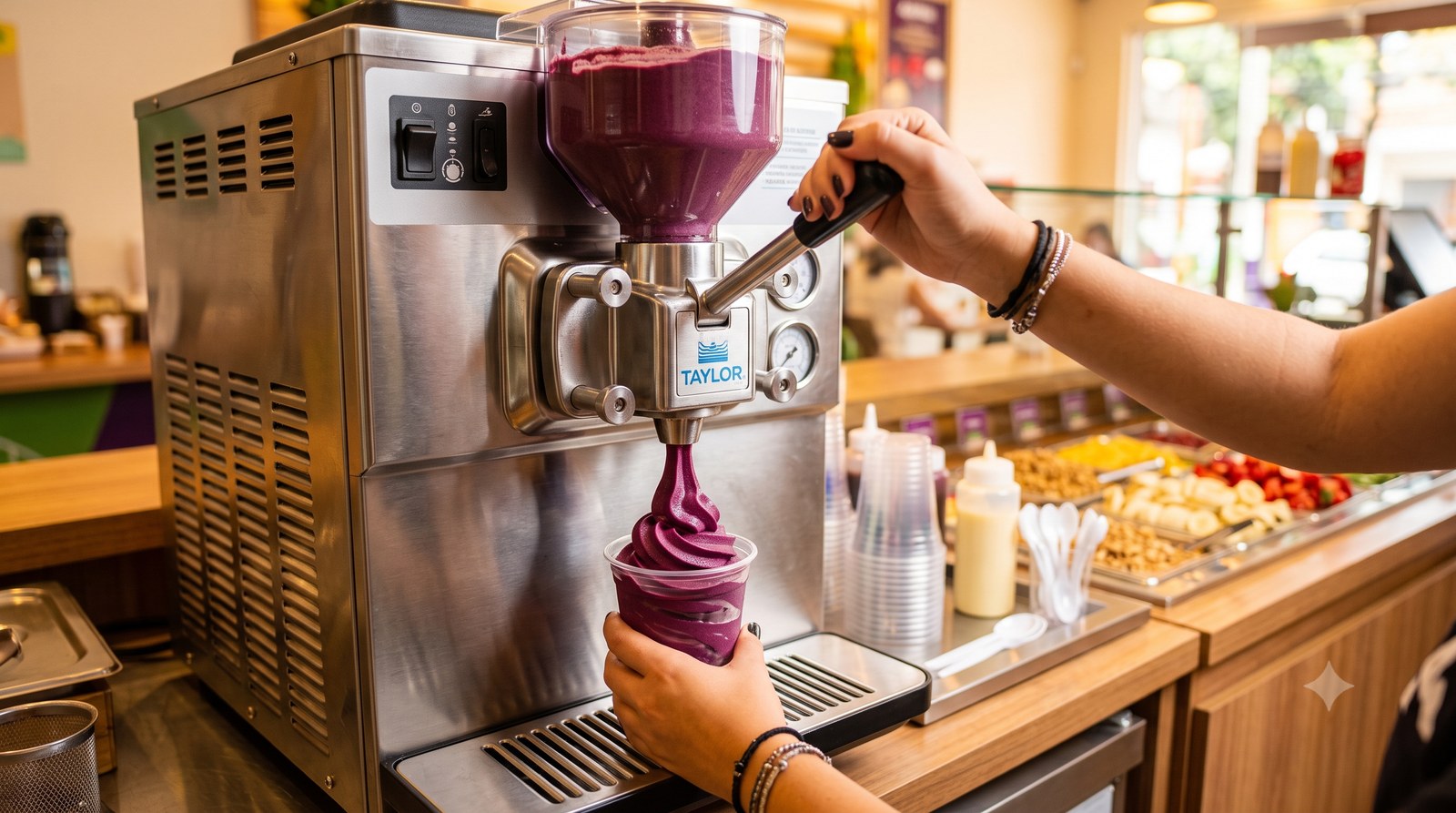
The scene repeats itself every Brazilian summer. Thirty-five degrees of heat, a queue at the door of the ice cream parlour, and the cup of creamy açaí that goes out at a price nobody questions. Except the one who profits from that queue is not the person standing in it: it is the entrepreneur who put an ice cream machine on the counter of their own site, and the importer who realised that machine costs, at source, a fraction of what is charged for it in Brazil.
What the açaí and soft-serve machine is
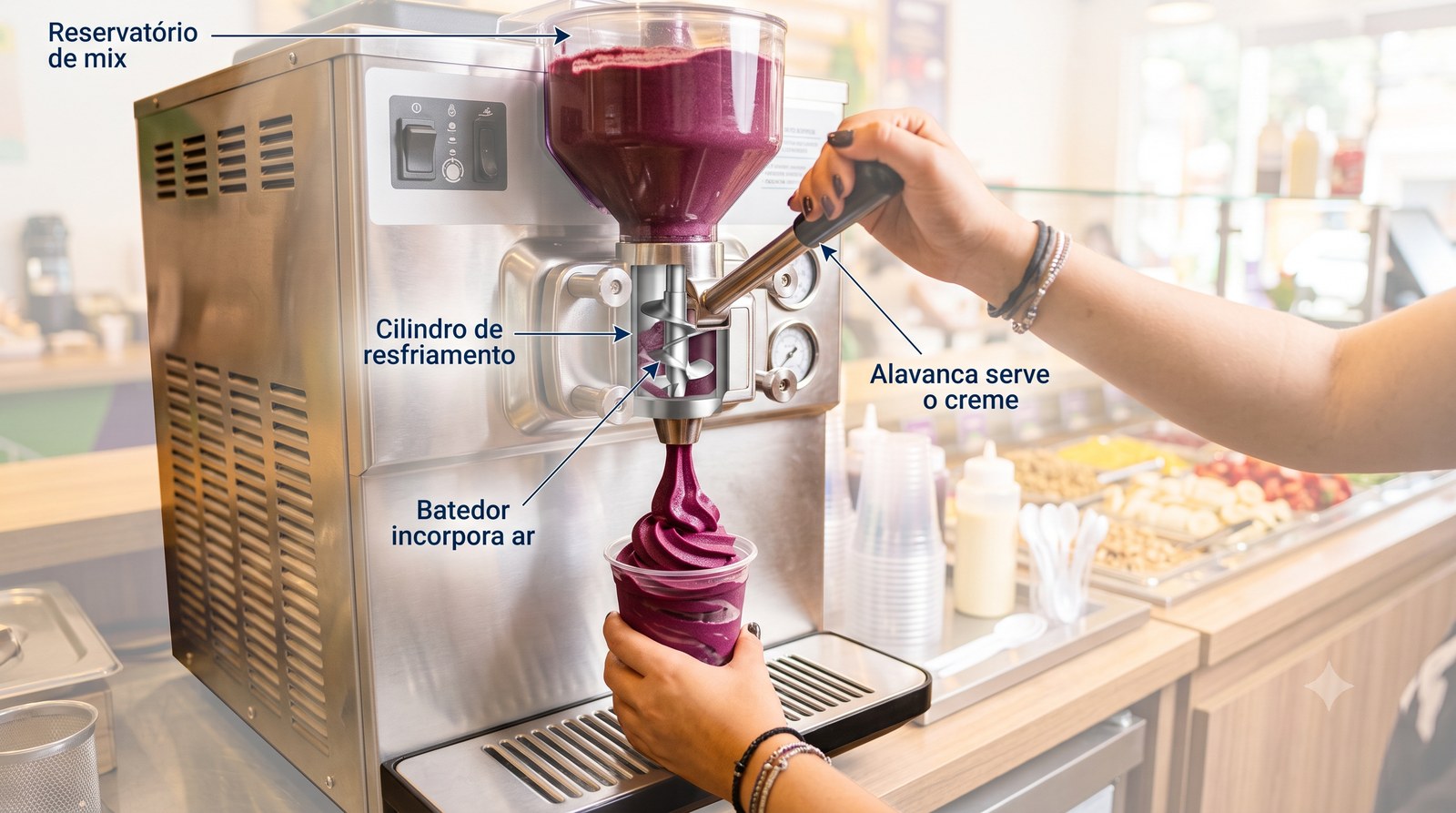
It is a soft-serve ice cream machine. You fill the hopper with a mix or pulp, and it chills and whips the product until it becomes creamy, serving it on the spot through the lever. The same machine makes creamy açaí, gelato and frozen yoghurt, simply by changing the mix. There are countertop models, for small sites, and floor-standing ones, for high volume, with one to three flavours plus the twist option.
It is not complex equipment to operate. That is exactly why it turns over: a low barrier to entry, a product with a very high perceived value and a scene that sells itself in video, with the swirl coming out into the cup.
Why this is an opportunity for Brazil
Brazil is the country of açaí and ice cream, with a market that boils over in summer and never quite cools down the rest of the year. And there is a legion of people wanting to set up their own business with little capital. The ice cream machine fits exactly there, and the sums work for two importer profiles at once: whoever buys to operate and whoever buys to resell the equipment.
- A machine that pays for itself: the input is cheap (pulp, mix, powdered milk) and the cup served sells dear. It is one of the food service businesses where the return is counted in a season, not in years.
- Cheap to buy at source, resells well: the gap between the factory price in China and that of an assembled machine at Brazilian retail opens a comfortable margin, both for the equipment reseller and on the repeat-purchase consumables.
- Timing with a summer bonus: the machine is not seasonal, but the sales peak is. With the manufacturing and sea freight lead time (60 to 120 days), placing the order in July or August is what guarantees stock for the summer and for anyone wanting to open a site in the high season.
- Wide audience: the ice cream parlour, the snack bar, the açaí shop, the food truck, the bakery, the beach kiosk. And every machine sold becomes a customer for consumables and parts for the years that follow.
Before importing: being electrical equipment, confirm the INMETRO requirement and the right voltage (110V, 220V or three-phase). Because it comes into contact with food, the parts that touch the product must be made of non-toxic, suitable material (stainless steel and food-grade plastics), a point connected to the ANVISA rules. The quality of the compressor varies a great deal between factories, and this is a case where inspecting before shipment and securing technical support avoids buying a problem in the middle of the high season.
Customise the specification (OEM)
Importing machinery from China is not picking the catalogue model and hoping it works out. The manufacturer adjusts the equipment to your point of sale, and that is where having a partner at source separates whoever resells a commodity from whoever builds a serious operation.
- The right capacity, flavours and voltage: countertop or floor-standing, one to three flavours, 110V, 220V or three-phase, with the compressor suited to a hot climate.
- Your brand on the equipment (private label / OEM): name, colour and a control panel in Portuguese, to resell as a line of your own.
- After-sales and parts agreed at purchase: compressor, beaters, seals and the technical support, which on a food machine in the high season is what keeps the site open.
That usually calls for negotiating directly with the factory and validating a sample before the batch. BCVN finds the right manufacturer, closes the specification, tests the machine and makes sure the support really exists, and not only in the proposal.
Where to buy ice cream machines in China
The açaí and ice cream machine is a classic of the food service equipment sector, and it turns up in force at the main fairs:
- Canton Fair, Phase 1 (Machinery and Equipment): the biggest starting point, with food equipment manufacturers side by side and the chance to see the machine serving on the spot.
- Hotelex, in Shanghai: the largest food service and hospitality equipment fair in China, with aisles dedicated to ice cream, gelato and drinks. It is the sector fair that goes deeper into what the Canton Fair introduces.
- Yiwu Trade Fair: ideal for closing on the disposables and repeat-purchase consumables, such as cups, spoons and tubs, at the largest small-commodities wholesale market in the world.
Next edition, Canton Fair 2026 (140th): Phase 1, with machinery and equipment, runs from 15 to 19 October 2026, at the Pazhou complex in Guangzhou. It is the chance to see the machine serve in front of you before closing the purchase, which changes everything when it comes to a production investment.
Read the complete guide to the Canton Fair 2026
The açaí and ice cream machine is not a bold bet. It is the equipment that lowered the barrier to entry in frozen food service and created, in one go, a market of people who operate and a market of people who sell machines. For the Brazilian importer, the question is not whether it is worth it, but buying the right machine, at the right voltage, from the manufacturer that will still be around to sell the next spare part. If you want to open or to stock up for the summer, the decision belongs to July.
Frequently asked questions about importing açaí and ice cream machines
Do I need certification to import açaí and ice cream machines?
Yes. Being electrical equipment, the machine normally requires INMETRO certification, and the voltage has to be confirmed (110V, 220V or three-phase). Because it comes into contact with food, the parts that touch the product must be made of non-toxic, suitable material (stainless steel and food-grade plastics), a point that connects to the ANVISA rules. Check all of it before placing the order.
What is the difference between a soft-serve machine and an açaí machine?
It is usually the same family of equipment, the soft-serve ice cream machine. It chills and whips a mix or pulp until it becomes creamy and serves it on the spot through the lever. The same machine serves creamy açaí, gelato and frozen yoghurt, simply by changing the mix. There are countertop and floor-standing models, with one to three flavours plus the twist.
How much does it cost to import an açaí machine from China?
The cost at source is a fraction of the price of the machine already assembled and resold in Brazil, which opens a margin both for whoever is going to operate it and for whoever is going to resell the equipment. The figure varies with the capacity, the number of flavours and the compressor. BCVN quotes the right machine for your volume and point of sale.
Where can I find ice cream machine suppliers in China?
At the Canton Fair (Phase 1, machinery and equipment) and at the food service and hospitality equipment fairs, such as Hotelex in Shanghai. The Yiwu Trade Fair helps with closing on the consumables and disposables, such as cups and spoons. BCVN validates the manufacturer, the technical support and the supply of parts.