
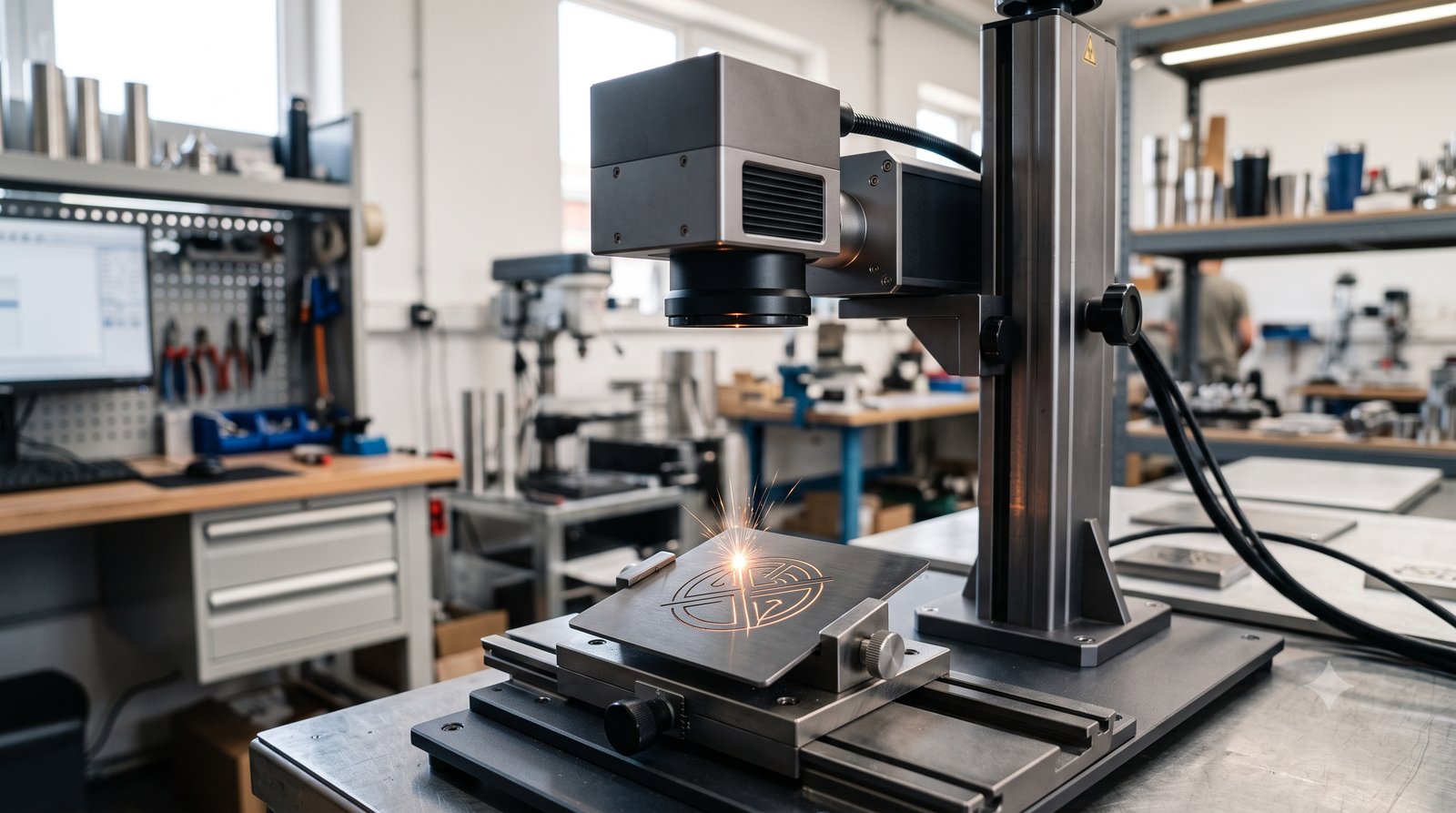
There is a kind of business that needs no stock. It does not buy goods to resell, it buys a machine and sells what the machine does. Laser engraving on metal is one of those: the customer brings the mug, the knife, the tag or the part, and pays for the mark that stays there for ever. The one who sees the opportunity is not the person who wants an engraved mug, but the importer who realised that the machine behind that service leaves China for a fraction of what it costs assembled here.
What a fibre laser marker is
The fibre laser marker is a machine that engraves metal permanently, using an optical fibre laser source. It marks steel, aluminium, brass, stainless steel and most metals, plus some plastics, with logos, text, serial numbers, QR codes and artwork. The mark is neither ink nor a sticker: it is the metal itself altered by the laser, and that is why it does not flake, does not fade and stands up to use.
Here the distinction that decides the purchase is worth making: the fibre laser is for metal. It does not replace the CO2 laser machine, which is for wood, acrylic, leather and fabric. They are sisters, not rivals: many personalisation shops end up with both, one for each material and each customer.
Models and variations
"Laser marker" is not a single product. In the laser aisles of the Chinese fairs it is a whole range, and each format opens up a different customer and a different price in your business:
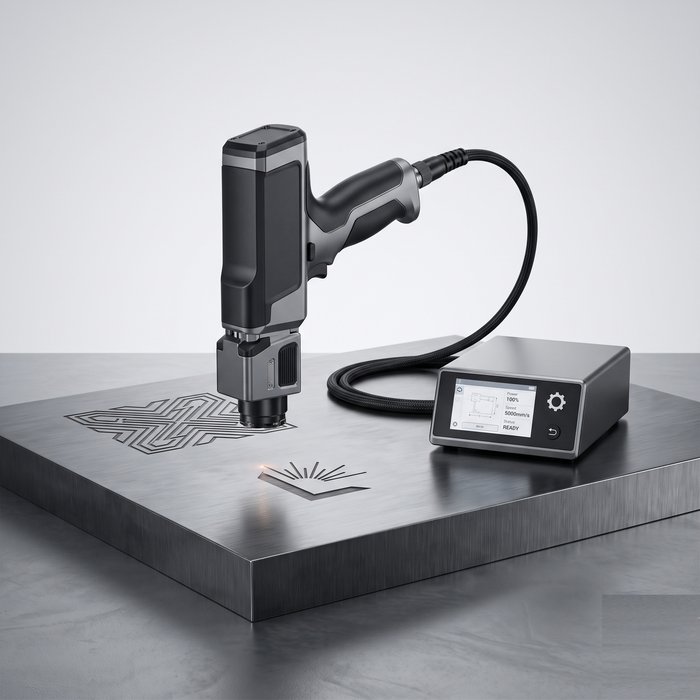
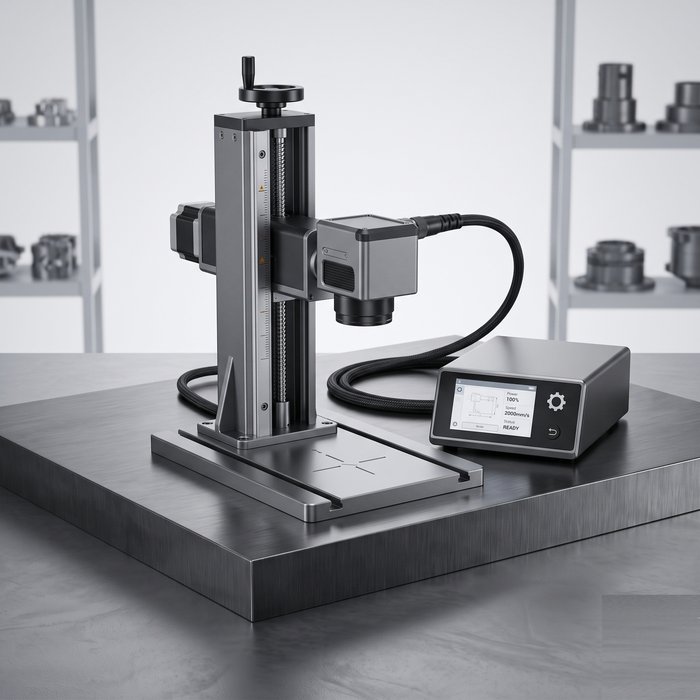
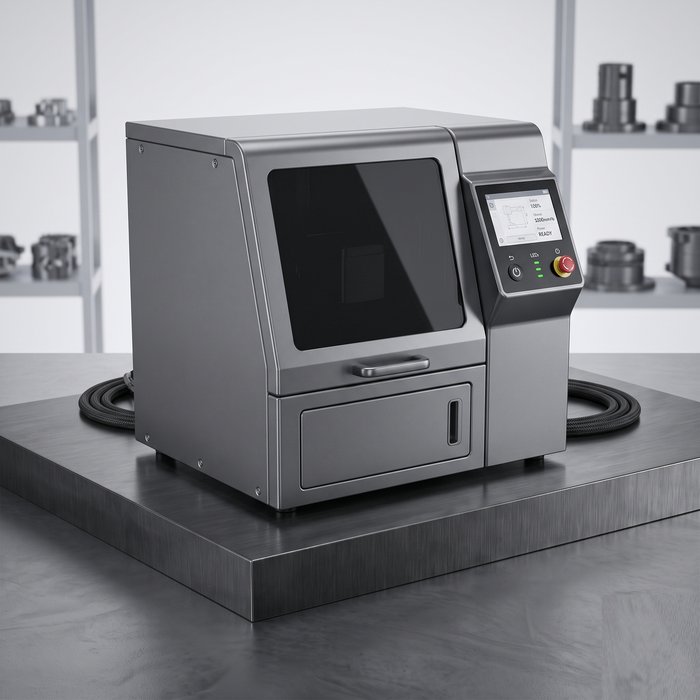
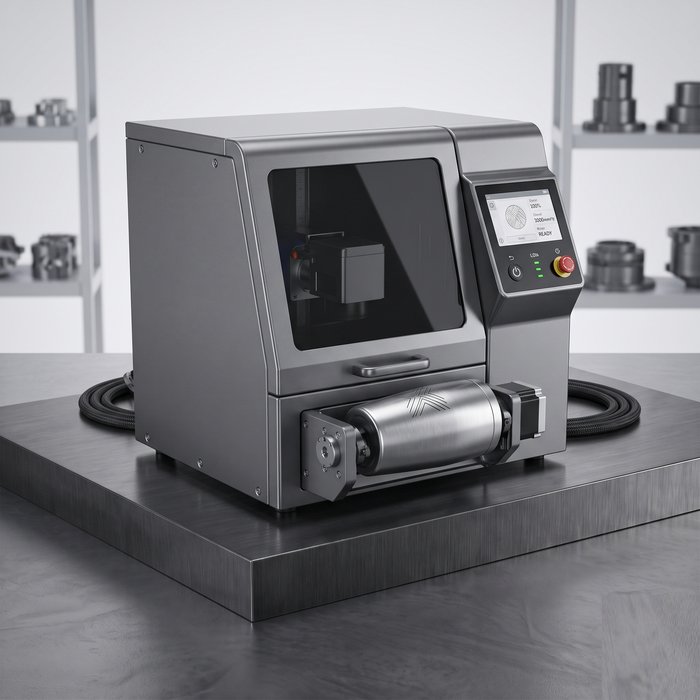
It is this variety that makes the trip worthwhile. The model with a rotary axis, for example, is the one that opened up the market for personalised insulated tumblers and mugs; the handheld one serves the industry that needs to mark a large part without moving it. Seeing all four working side by side is what shows which of them is your business.
Why this is an opportunity for Brazil
Brazil has a personalisation market that keeps growing, from the corporate gift to the gift shop, from the handmade knife to the insulated tumbler. And it has an industry that needs traceability, numbering parts and marking batches. Both buy the same machine, and almost all of it is imported.
- It sells a service, not a piece: whoever buys the marker does not resell markers, they sell engraving. It is a service margin, with no stock sitting idle, and the machine working for years.
- A return you can calculate: this is not an impulse product. The buyer knows how many engravings a month pay for the machine, and decides with the numbers in hand. It is the considered lead, the one with the highest value.
- Low cost at source, high value here: China concentrates the world's manufacturing of fibre lasers. The gap between the cost at source and the Brazilian shelf price is what opens up the business.
- Two customers in the same item: it serves the entrepreneur setting up the personalisation service and the distributor or service workshop that wants the complete line, with the recurring sale of sources, lenses and parts behind it.
Before importing: a machine is work equipment and falls under NR-12, the machine safety standard. Also confirm the laser class and the eye protection specific to fibre (CO2 goggles do not protect against the fibre wavelength), the INMETRO certification of the electrical side and the correct voltage. And confirm the laser source: it has a working life, the machine stops without it, and continued supply is part of the negotiation. This is a case where inspecting before shipment confirms the real power of the source. See also how to import industrial equipment from China.
Customise the specification (OEM)
Importing a marker from China is not a matter of picking the catalogue model and hoping. The specification is negotiated, and that is where money is made or lost later:
- Power of the source: the power (20W, 30W, 50W or more) defines what the machine marks and how fast. The wrong power for your material is money badly spent in both directions.
- Working area and accessories: the size of the bed, the rotary axis for tumblers and rings, and the enclosed cabinet with extraction, according to your product and the standard.
- Software and support: software in Portuguese or compatible, training and the after-sales that keeps the operation going, with replacement sources and lenses guaranteed.
- Own brand: for the distributor, the line can be closed with your brand on the machine and on the packaging, creating an equipment brand instead of reselling everybody else's.
That calls for direct negotiation with the factory and a sample test before the batch. BCVN finds the right manufacturer, settles the specification, tests the engraving and makes sure the machine arrives within the standard.
Where to buy fibre laser markers in China
Laser is a strong and concentrated sector of Chinese industry, and the machine appears at the dedicated laser fair and in the machinery aisle of the universal fair:
- CIOE (laser and optoelectronics, Shenzhen): from 9 to 11 September, it has the dedicated laser hall, the largest concentration of manufacturers in the sector in one place. It is the ideal fair for anyone making laser their business.
- Canton Fair, Phase 1 (machinery): from 15 to 19 October, it has the machinery aisle with laser manufacturers among the whole industrial offering. Good for anyone who wants laser as one line among several.
- Hong Kong Electronics Fair: useful for anyone combining personalisation with electronics and tech gifts.
The itinerary the dates draw for you: CIOE, in September, and the Canton Fair, in October, are both in the Pearl River Delta region, a little over an hour from each other. You can see the depth of laser at CIOE and come back for the general variety at the Canton Fair. See the full calendar of China's 2026 trade fairs.
It is also worth looking at the DTF printing machine and the benchtop CNC laser engraver, which round off the line for anyone setting up a complete personalisation studio.
A fibre laser marker is not a shop-window find, it is a business decision. It does not sell on impulse, it sells on arithmetic, and that is why it is the kind of import that most rewards whoever goes to the source: here you do not buy a photograph, you buy a machine that needs the right source, the right standard and a manufacturer who will answer the phone next year. For whoever wants to make a living personalising metal in Brazil, it is the machine that starts the business.
Frequently asked questions about importing fibre laser markers
What is a fibre laser marker and what is it for?
It is a laser engraving machine that marks metal permanently: logos, serial numbers, text and artwork on steel, aluminium, brass and most metals, plus some plastics. Unlike the CO2 laser, which is for wood, acrylic and leather, the fibre laser is the standard for metal. It is used to personalise gifts and mugs, number parts in industry, mark tools and jewellery, and to build a high-margin engraving service on demand.
What is the difference between a fibre laser and a CO2 laser?
They are for different materials. The fibre laser marks metal and some plastics, and it is the right one for steel, aluminium, brass, tools and jewellery. The CO2 laser cuts and engraves organic materials: wood, MDF, acrylic, leather and fabric. They do not replace each other, they complement each other: many personalisation shops end up with both, one for each type of material and customer.
Does a laser marker imported from China need certification?
Yes. A machine is work equipment and falls under NR-12, the machine safety standard, which requires guards, an emergency stop and a manual in Portuguese. Also confirm the laser class and the eye protection specific to fibre, as well as the INMETRO certification of the electrical side and the correct voltage (110V or 220V). A machine outside the standard creates labour liabilities and insurance problems, and bringing it into compliance afterwards costs more than specifying it properly before the order.
Can I import just one laser marker to test it?
It does not pay off. BCVN is an import consultancy for retailers and companies, and freight and customs clearance only add up in a batch that fills volume. A single unit costs more imported than bought from a distributor in Brazil. It makes sense for whoever is setting up or expanding an engraving service, for the distributor and for the service workshop that also wants the line of parts, sources and lenses.
Where can I buy fibre laser markers in China?
At CIOE, in Shenzhen, from 9 to 11 September 2026, which has the dedicated laser hall and is the largest concentration of manufacturers in the sector, and at the Canton Fair, Phase 1, from 15 to 19 October, in the machinery aisle. CIOE gives you depth in the sector; the Canton Fair gives you the laser among several other categories. BCVN validates the manufacturer, the laser source, the NR-12 side and the supply of parts.