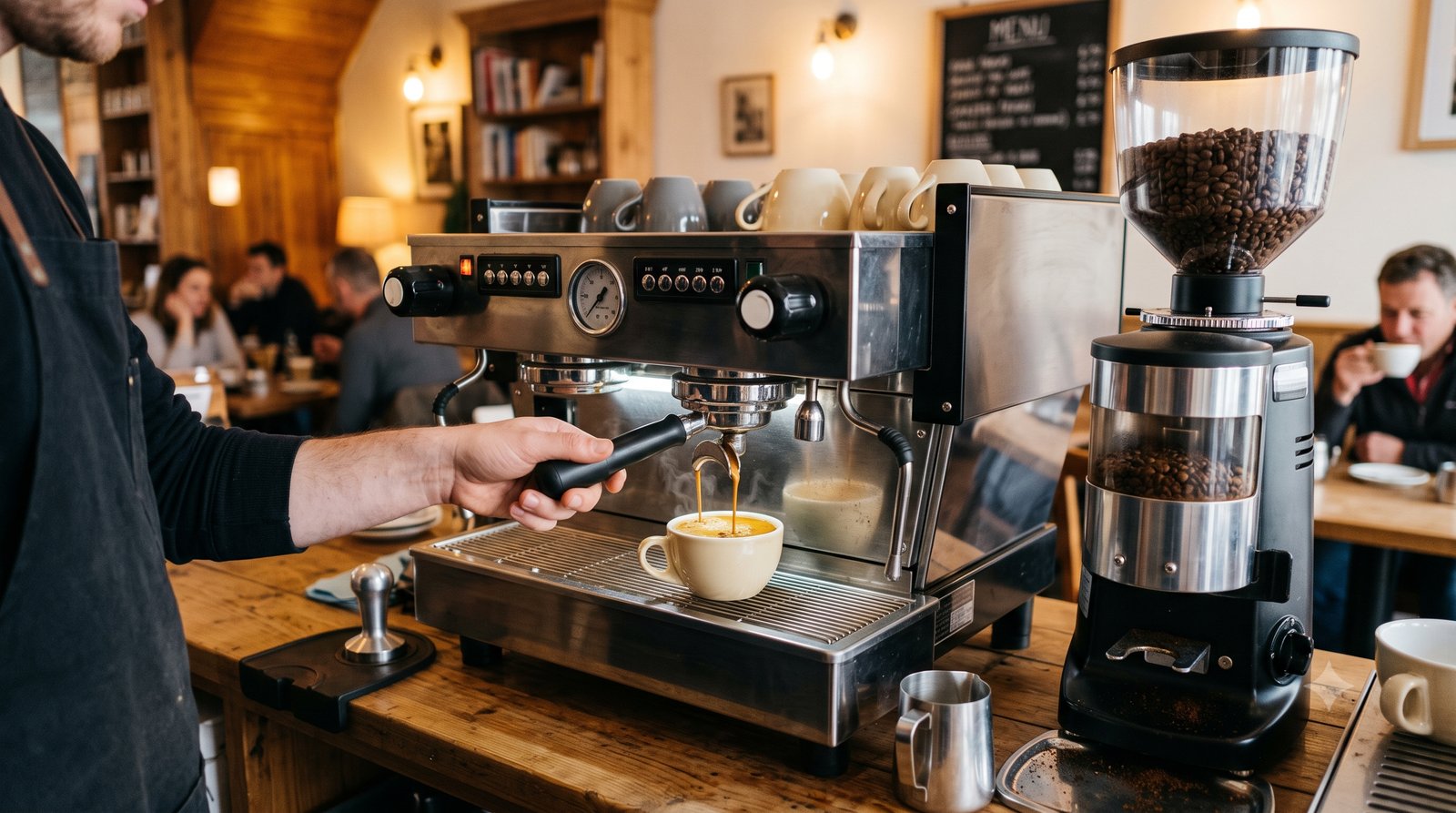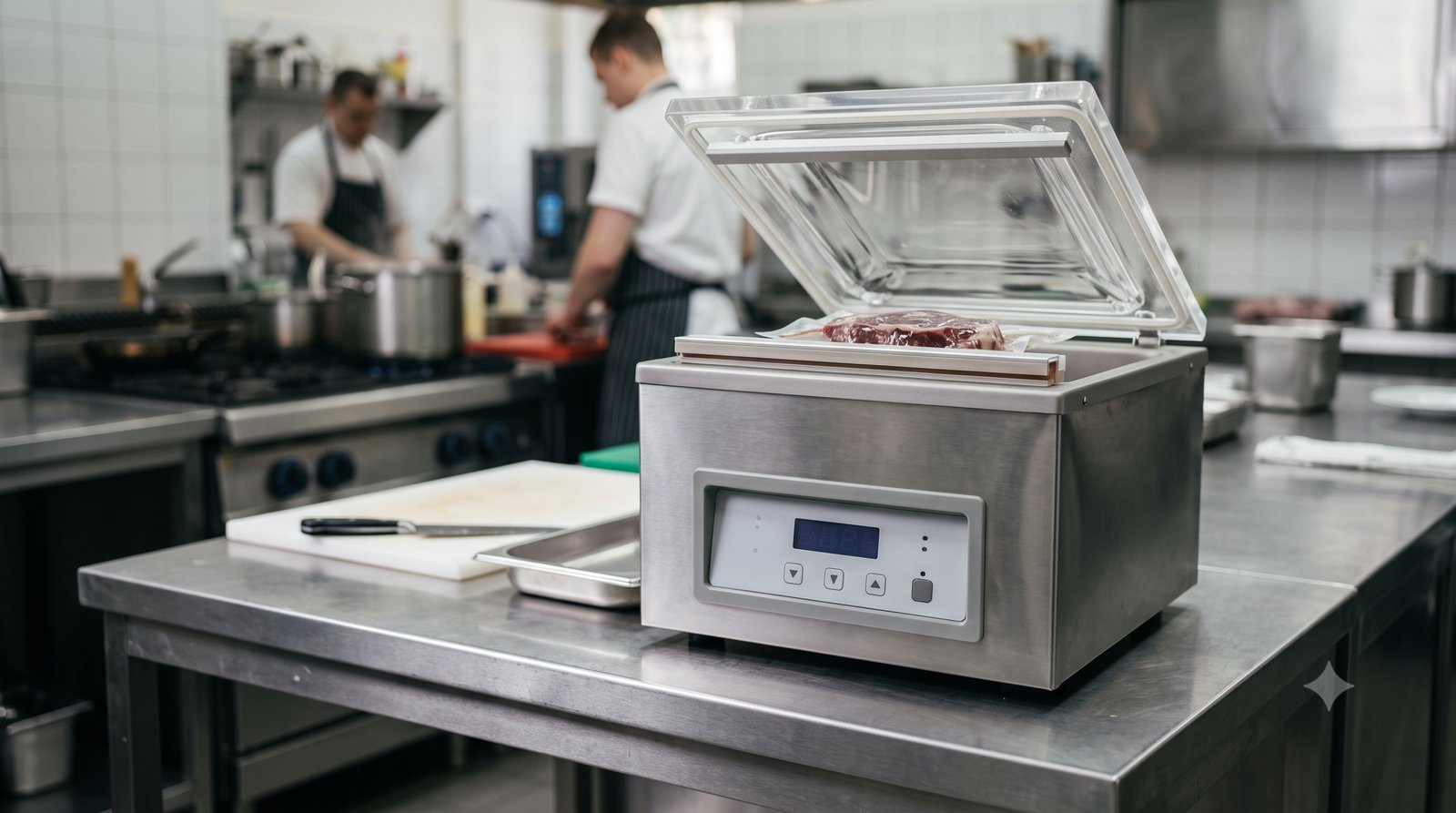
Brazilian food service renews itself constantly. Restaurants open, restaurants close, the delivery only kitchen grows, the franchise standardises ten branches at once and the neighbourhood bakery turns into a coffee shop. Each of those moves is a whole kitchen being fitted out, and almost every item in that kitchen comes from China at a price that domestic or European equipment cannot match. For anyone reselling, representing a brand or equipping their own chain, the sums add up comfortably.
What misleads is thinking the logic is the same as for any other machine. It is not. A professional kitchen is not one piece of equipment, it is a system that depends on gas, water, power and extraction to work, and that operates under health inspection every day. When one item in that system arrives wrong, the loss does not wait for the next set of accounts: it shows up at the next lunch service. If what you want is a step by step guide to finding a supplier and clicking buy, this is not it. This vertical is not decided at the click, it is decided in the specification.
The three yardsticks that fall on the importer, not the factory
Professional kitchen equipment goes through three different yardsticks, and it is rare for anyone to remember all three before the order. None of them is the Chinese manufacturer’s responsibility: they all fall on the CNPJ that imported.
The electrical side of several professional use families falls under compulsory certification. Without the mark, the product cannot be sold, and the irregularity surfaces at customs or at the first inspection of the premises.
Dough mixers, sheeters, slicers, meat mincers and kneaders have moving parts and blades. The machine safety standard requires guarding, interlocks, an emergency stop and technical documentation. Inspectors shut down equipment that is already installed.
Every surface that touches food answers to the sanitary rules on food contact materials, and the municipal inspectorate requires a cleanable finish on installed equipment. It is the yardstick that exists only in this vertical.
Worth insisting on a point that confuses many people: CE and CCC do not count as Brazilian conformity. CE is a European marking and CCC is China’s own compulsory certification. The equipment can carry both and still be irregular here. To see which families fall under compulsory certification, see the guide to products that require INMETRO, and anyone who also brings in the food, and not just the machine that prepares it, needs to understand first the MAPA approval route.
The question that decides the order: before discussing price, the question is "does this equipment touch food, have moving parts or depend on gas?". The answers define which of the three yardsticks you will face, and none of them can be settled after the cargo arrives. Bringing equipment into line in Brazil costs multiples of having specified it at source, and in the meantime the kitchen sits idle.
The steel that looks the same in the photo and is not
This is where the cheap quote explains itself, and the hardest thing to see from a distance. A professional kitchen is made of stainless steel, but stainless is not one single material. AISI 304 is the industry standard: austenitic, it stands up well to salt, acid, hot fat and aggressive cleaning products, which is exactly a kitchen’s daily routine. AISI 430 is ferritic, costs considerably less, is magnetic and stands up far less well to the same environment.
In a catalogue photo the two are identical. On a worktop in use, the difference shows within a few months, as staining, pitting and a door that warps. And here is the trap: when the order says only "stainless", without the grade and without the sheet thickness, the cheapest quote that comes back was almost always priced on thin 430. The supplier did not lie, they answered exactly what was asked.
Thickness is the silent sibling of the same problem. Thinner sheet lowers the price, and also lowers the rigidity of the worktop, the life of the hinge and the stability of the cold room door. None of that is measured from an image: it is measured with the material in your hand, at the factory, which takes us straight to what a pre-shipment inspection settles and a catalogue does not.
Gas, water and extraction: what does not come in the box
Ordinary industrial equipment needs a socket and space. A professional kitchen needs infrastructure, and it is the infrastructure that usually delays the opening while the new equipment waits propped against the wall.
- Gas. Equipment quoted for natural gas is not the same as for LPG: the injectors and the settings change, and the working pressure has to match the installation. Add to that the design and the fire service approval, which are the establishment’s obligation and have their own timeline.
- Water. Ice machines, combi ovens, dishwashers and professional coffee machines depend on adequate pressure and on treatment at the inlet. Hard water destroys elements and boilers in a short time, and that bill arrives as maintenance, not as a factory defect.
- Extraction. The hood has to be sized for the thermal load of the equipment sitting under it, not chosen by the size of the wall. A poorly extracted kitchen turns into a problem with the neighbours, with the inspectorate and with staff turnover.
- Power. Three phase, single phase and the 60 Hz frequency have to be defined before production, because motors and heating elements are specified in the order, not swapped at destination.
The classic mistake is buying the equipment before knowing what the site can take. The right order is the reverse: first you find out the available gas, water, electrical supply and extraction, then you specify the machine that is going to live there. Anyone selling to chains learns this fast, because every new branch has a different limitation.
The mistakes that bring the kitchen to a halt
1. Asking for "stainless" without stating the grade and the thickness It is the costliest mistake in this vertical, because it only appears months later, when the worktop stains and the door warps. An incomplete specification is not a saving, it is a decision the supplier takes on your behalf.
2. Buying the machine before knowing the site Wrong gas, wrong pressure, three phase power that does not exist in the building, an undersized hood. The equipment arrives perfect and sits propped up waiting for building work nobody costed.
3. Ignoring the machine safety standard on equipment with moving parts A dough mixer or a slicer without guarding and without technical documentation is a liability installed in the middle of the operation. Labour inspectors shut the machine down wherever it stands, and nobody retrofits a sheeter in the middle of service.
4. Treating spare parts as a matter for later Heating elements, thermostats, gaskets, belts and compressors are wear items. Without stock travelling with the order, the first failure turns into weeks of waiting, and in this vertical weeks of waiting mean service not sold every single day.
5. Classifying the NCM code by the trade name The same machine changes code according to function, capacity and drive, and the rates change with it. Picking the cheapest code without a technical basis is an invitation to reclassification, a fine and cargo held. See NCM and tariff classification and the mistakes that get cargo held.
What cannot be settled from a distance
There is plenty of content teaching you to import a professional kitchen on your own, and it tends to stop precisely where the business begins. The steps that decide the outcome are not the ones done in front of a computer, with a photo and a catalogue. They are these:
- Knowing whether the factory is a factory. In this category middlemen are plentiful, because assembling worktops and counters looks simple. A real factory has cutting, bending, welding and polishing on its own line, and that is what determines the finish the inspector will look at.
- Confirming the grade and the thickness on the material. Not on the PDF. With the test at the factory, with the sheet in your hand, before the whole batch is produced in 430 when the order said 304.
- Seeing the equipment running with real product. The oven baking, the mixer with dough in it, the cold room pulling down temperature with a load inside. Declared capacity and real capacity only meet at that moment.
- Looking at the sanitary finish. Rounded corners, smooth welds, no crevices where dirt collects, adjustable feet that allow cleaning underneath. It is the detail that separates approved equipment from equipment that generates a notice.
- Negotiating what comes after the sale. A wear parts kit, a warranty with written conditions, manual and control panel in Portuguese. That is won with presence, language and track record, and almost never obtained by message.
None of these steps fits in a tutorial, because none of them is done remotely. This is where a partner at source stops being a comfort and becomes the difference between the kitchen that opens on time and the one that opens three months later, with half the budget spent on repairs.
The sum that rarely appears: the cheapness of importing alone ignores the cost of a day at a standstill. A kitchen that does not open does not just fail to earn back the equipment, it fails to earn a whole day of service, with staff paid and rent running. The partner does not make the operation dearer, it removes the risk that blocks the opening.
Spare parts and the cost of a day at a standstill
In consumer goods, after sales is a detail. In industrial equipment, it is half the decision. In food service, it is the whole decision, because the machine that stops does not delay a delivery, it cancels a sales shift that does not come back.
Three things define that scenario, and all three are settled before the order: whether there is a stock of wear parts travelling with the equipment, whether the warranty has written conditions for claiming, including who pays the freight on the part, and whether there is somebody able to diagnose over video while the kitchen waits. A supplier who has already exported to Brazil usually has all three answers ready, and that is what separates the good supplier from the cheap one.
To build the real cost of the operation, beyond the proforma price, it is worth seeing what it costs to import from China and the guide to freight from China to Brazil. Kitchen equipment takes up a lot of volume for little weight, which changes the container calculation and favours anyone able to fill their own load. Anyone without an import structure can operate through a third party importer.
Where to see the equipment running before buying
The best way to choose kitchen equipment is not from a catalogue, it is by seeing the machine running and talking to whoever makes it. Three fronts concentrate the sector in China:
The country’s food, drink and hospitality fair, where the food service chain is present with technical depth: ovens, refrigeration, coffee, bakery and packaging. See the guide to FHC China.
The machinery, electronics and equipment phase of China’s largest general trade fair, in Guangzhou, where food processing machinery appears alongside the rest of industry. See the guide to Canton Fair Phase 1.
The textiles, health and food phase, useful for anyone who, besides the machine, also brings in ingredients, disposables and packaging. See the guide to Canton Fair Phase 3.
The October and November dates fall in different cities, so the trip pays off far more with an itinerary built in advance: see the China trade fair calendar 2026. Being at the fair lets you compare dozens of manufacturers in hours, separate those who produce from those who only resell, and negotiate customisation with someone who has the power to decide, including own brand, private label and OEM, which in this vertical applies to anyone wanting to standardise a chain with their own identity.
The neighbouring guides are also worth reading: industrial equipment, for anyone buying heavy machinery, and home appliances, for the line that serves the end consumer.
Frequently asked questions about importing kitchen equipment from China
Does commercial kitchen equipment imported from China need INMETRO certification?
It depends on the product family. The electrical side of several professional use appliances falls under compulsory certification, and the mark answers to the CNPJ that imported, not to the Chinese factory. But INMETRO is only one of the yardsticks: machines with moving parts, such as dough mixers, sheeters, slicers and meat mincers, have to meet the NR-12 machine safety standard, and every surface that touches food answers to the sanitary rules on food contact materials. A CE or CCC certificate from the manufacturer replaces none of the three.
What is the difference between 304 and 430 stainless in a professional kitchen?
304 is the austenitic stainless used as standard in professional kitchens, with good resistance to corrosion from salt, acid and cleaning products. 430 is ferritic, cheaper, magnetic and stands up far less well to the same environment, staining and corroding with daily use. In a catalogue photo the two are identical. When the order says only stainless, without specifying the grade and the sheet thickness, the cheapest quote almost always came from thin 430, and the difference only shows months later, in the stained worktop and the warped door.
Does gas equipment made in China work in Brazil?
It works, provided the specification matches the gas and the working pressure at the installation site. Equipment quoted for natural gas is not the same as for LPG: the injectors and the settings change, and using one in place of the other compromises the flame and safety. Besides that, the gas installation in a professional kitchen depends on a design and on fire service approval, which is the establishment’s responsibility and does not come in the box. That is the item that most often delays the opening of a new operation.
Who can import commercial kitchen equipment from China?
To import on a regular basis you need a CNPJ with a compatible activity and RADAR Siscomex authorisation, the registration that allows a company to operate in foreign trade. It is the importing CNPJ that answers for the conformity of the equipment before INMETRO, the labour inspectorate and the Receita. That is why BCVN serves chains, distributors, resellers and operations fitting out several sites, and not the purchase of a single item by an individual.
How do I import kitchen equipment from China without stopping the operation?
By settling at source what Brazil charges for at destination: fixing the stainless grade and thickness in writing, confirming voltage, gas and pressure before production, requiring the sanitary finish and the NR-12 guarding on the assembly itself, classifying the right NCM code and negotiating wear parts, warranty and a manual in Portuguese within the order. Then, seeing the equipment running with real product before shipment. It is exactly the part that is not done from afar, with a photo and a catalogue, and it is where BCVN comes in.
Trade fair products in the China Showcase
Real finds from the fairs this guide covers, with the cost and resale logic of each one. See more in the China Showcase.